Cheap Production Means More Expectations, More Work
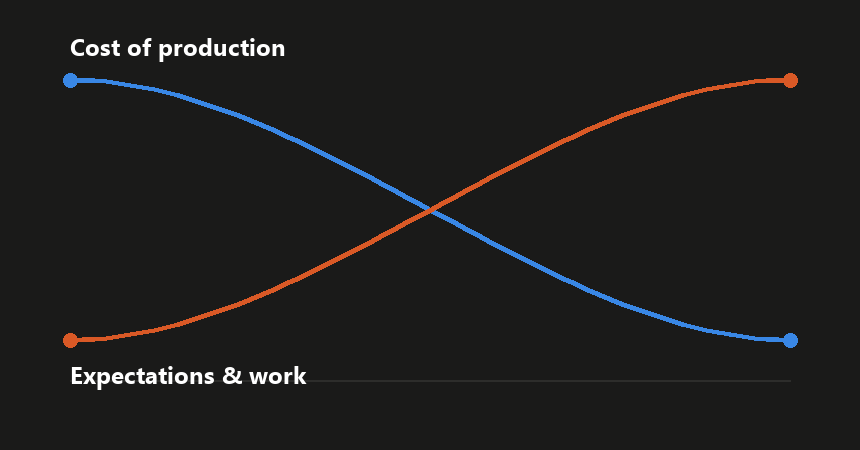
A lot of developers are saying that game development, or software engineering in general, is over in the era of AI, but I think it will not (I hope I am not wrong).
What’s actually coming is higher expectations from players, and more work to meet them. We’ve seen this before.
Before engines, building the tool to build a game took years, big cost that filtered out everyone who can’t afford to have a big talented team to build one. Once engines took that cost to near zero, the floor moved, and what it took for a game to be decent increased.
A 1998 game could ship with flat lighting, choppy performance, and humble levels built by hand, and nobody minded, those took a dedicated engine team to get them right. Today the engine hands you realistic lighting, smooth performance, and world-building tools by default. Nobody praises good lighting. They notice its absence.
The tool made each task cheaper, not free. It didn’t hand teams back their lost years building the engine and tools,those years went to work that wasn’t worth doing before: better animation, more content, accessibility, cross-platform, live updates.
That’s the pattern. It repeats.
Cheap production does not mean less work. It raises what players expect. Whatever becomes easy stops being a feature and quietly becomes the minimum.
Games are about to go through the same thing. If an artist can generate ten environment variants in an afternoon instead of one in a week, nobody will decide we need fewer artists or smaller worlds. They’ll decide the world should be ten times denser, that every variant should be good, and that reusing the same asset is now lazy, not just a limit everyone used to accept.
So the work is not disappearing. It is moving up a layer, to the parts that are still hard and only few get it right:
Knowing what is actually fun. Judging whether the thing you built made the game better or just bigger. Cutting content that took real effort just because it doesn’t make the experience fun for the player. Holding on to one clear vision when the tools will happily produce endless noise.
That part has not been automated, and it gets harder as production gets cheaper. When you can make anything, taste becomes the bottleneck. Volume was never the thing players wanted.
Here’s what actually bothered me, though.
Unity never shared its opinion with you about a level if it is fun or not. It rendered the level. It did not judge it. AI does not stop there. Ask it if the pacing is off, ask it what to cut, ask it whether the boss fight works, and it gives you an answer. That is not production. That is the exact job I just thought was safe.
Engines gave everyone a new floor, once, and then held still for twenty years. AI is not holding still. Every time it gets better at judging things instead of just making them, the floor moves again, and the part of the job that’s still yours gets smaller.
But it has to stop somewhere. AI can generate the world, grade the pacing, tell you what to cut, but it doesn’t want a game to exist. It has no vision to protect. Take the person out, and there’s nothing left to serve: just content, made because it could be, for nobody in particular.
That’s where it ends: with the person who wants the thing to exist in the first place. Not a job title, not a role, just someone deciding this and not that. Eventually, everyone doing this work ends up a creator, because that’s the one part no tool can take over. It’s just a person, wanting something specific.
You don’t get to keep the job you had. You get pushed into the harder half of it: less time producing, more time deciding. More responsibility for whether the thing is any good, and less room to hide behind how hard it was to make.
That is not the end of game development.
It is a promotion nobody was expecting.